

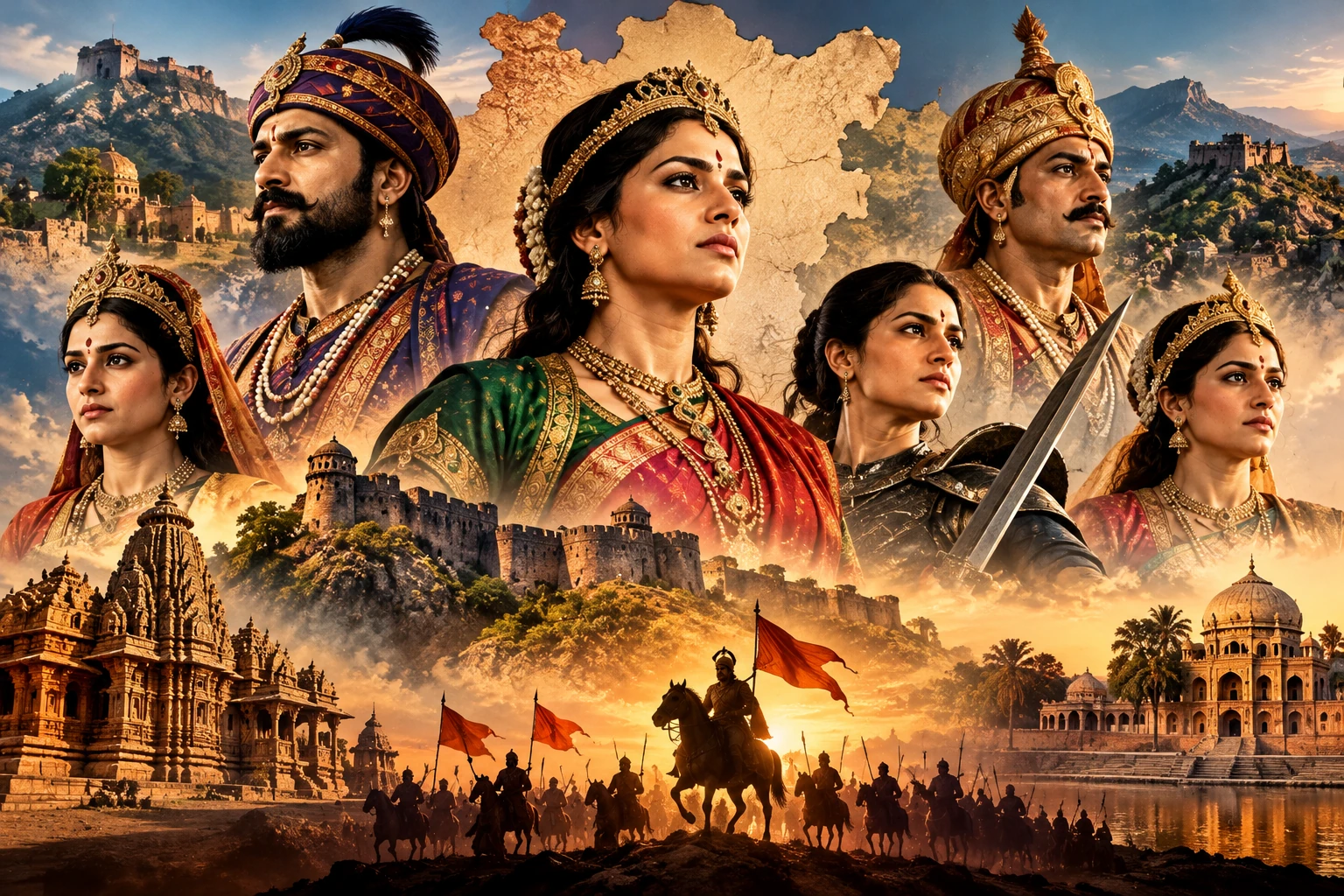
India’s history is filled with rulers who shaped kingdoms, defended territories, developed cities, and supported art, architecture, and culture. While names such as Ashoka, Akbar, and Maharana Pratap are widely recognized, many other kings and queens made important contributions that receive less attention in popular history.
From courageous queens who defended their kingdoms to rulers who improved administration and supported public welfare, their stories reveal the diversity of India’s past. Exploring these historical figures helps us understand that the country’s development was influenced by leaders from different regions, communities, and periods.
1. Razia Sultana: The Woman Who Ruled the Delhi Sultanate
Razia Sultana became the ruler of the Delhi Sultanate in 1236 and remains an important figure in medieval Indian history. She was the daughter of Sultan Iltutmish, who recognized her administrative abilities and selected her as his preferred successor over his sons.
Razia attempted to exercise authority as a sovereign ruler rather than remain a ceremonial figure. She participated in military and political affairs and sought to strengthen her position against powerful nobles who questioned her leadership.
Her reign lasted until 1240, when opposition among sections of the nobility contributed to her removal from power. Although her rule was relatively short, Razia’s story demonstrates the challenges faced by women who entered positions of political authority in medieval India.
Her legacy continues to attract interest because she occupied a throne traditionally dominated by men and attempted to govern amid intense political competition.
2. Rani Durgavati: The Warrior Queen of Gondwana
Rani Durgavati was a ruler of Gondwana in central India during the sixteenth century. After the death of her husband, Dalpat Shah, she governed on behalf of her young son and became known for her leadership and resistance to Mughal expansion.
Her kingdom included strategically important territories in the region of present-day Madhya Pradesh. Governing such a territory required political judgment, military organization, and the management of local resources.
In 1564, Mughal forces under Asaf Khan invaded her kingdom. Rani Durgavati resisted the campaign and fought to defend her territory. Facing military pressure and the prospect of defeat, she died during the conflict rather than surrendering to her opponents.
Her story is remembered as an example of resistance, determination, and political responsibility. It also highlights the role of regional kingdoms in shaping India’s history beyond the larger imperial narratives.
3. Ahilyabai Holkar: The Queen Who Focused on Public Welfare
Ahilyabai Holkar ruled the Holkar state in central India from approximately 1767 until her death in 1795. Unlike rulers remembered mainly for military conquests, she became widely associated with administration, public works, religious patronage, and the development of important pilgrimage centers.
She established her capital at Maheshwar, on the banks of the Narmada River. Her administration is associated with efforts to maintain order, support commerce, and improve facilities for travelers and pilgrims.
Ahilyabai also sponsored the construction and restoration of temples, ghats, wells, and rest houses in different parts of the subcontinent. The reconstruction of the Kashi Vishwanath Temple in Varanasi in 1780 is among the best-known examples of her patronage.
Her reign illustrates how a ruler could influence society through infrastructure and cultural support, not only through territorial expansion. Her legacy remains visible in several historical and religious sites today.
4. Rudramadevi: A Powerful Ruler of the Kakatiya Dynasty
Rudramadevi ruled the Kakatiya kingdom in the Deccan during the thirteenth century. The dynasty controlled important territories in present-day Telangana and neighboring regions, with Warangal serving as a major political center.
Rudramadevi succeeded her father, Ganapatideva, and governed during a period when regional powers competed for influence and territory. Her rule required maintaining relationships with local chiefs, managing the kingdom’s administration, and responding to military challenges.
Historical accounts describe her involvement in defending and consolidating Kakatiya authority. Her reign is significant because she exercised sovereign power in a political environment where male succession was commonly preferred.
The Kakatiya period is also associated with notable achievements in architecture, irrigation, and regional administration. Rudramadevi’s story therefore provides a window into the political and cultural development of medieval southern India.
5. Rani Abbakka Chowta: The Queen Who Resisted Portuguese Expansion
Rani Abbakka Chowta is remembered in coastal Karnataka for resisting Portuguese attempts to establish greater control over the region’s maritime trade.
She ruled Ullal, a strategically situated coastal territory near present-day Mangaluru. During the sixteenth century, Portuguese expansion across the Indian Ocean brought European trading powers into conflict with established coastal rulers and commercial networks.
Abbakka’s resistance is associated with the defense of Ullal and efforts to protect local political and commercial interests. Accounts of her campaigns describe conflicts with Portuguese forces, although details vary among historical and later traditional sources.
Her story highlights an important dimension of Indian history: resistance to foreign expansion did not occur only during the nineteenth-century colonial period. Coastal communities and regional rulers had already confronted European maritime powers centuries earlier.
Rani Abbakka’s legacy is especially important to the history of Karnataka and the broader story of India’s maritime past.
6. Maharaja Chhatrasal: The Founder of Bundelkhand’s Independent Power
Maharaja Chhatrasal was a seventeenth- and eighteenth-century ruler who established an independent kingdom in Bundelkhand, a region spanning parts of present-day Madhya Pradesh and Uttar Pradesh.
He began his struggle for regional independence during the reign of Mughal emperor Aurangzeb. Through military campaigns, alliances, and the consolidation of local support, Chhatrasal expanded his influence across Bundelkhand.
His political career demonstrates how regional leaders challenged imperial authority and created new centers of power during periods of political change.
Chhatrasal also developed relationships with other influential figures of his time, including the Maratha Peshwa Bajirao I. Their alliance played a role in the political developments of central India.
His legacy is closely connected with Bundelkhand’s regional identity and its history of resistance, state-building, and cultural development.
Why These Rulers Deserve Greater Recognition
These historical figures represent different approaches to leadership. Razia Sultana and Rudramadevi challenged established expectations about women ruling kingdoms. Rani Durgavati and Rani Abbakka are remembered for defending their territories against powerful opponents. Ahilyabai Holkar focused much of her legacy on administration and public works, while Chhatrasal built regional power during a period of imperial change.
Their experiences also remind us that Indian history cannot be understood through a handful of famous emperors alone. Regional kingdoms, coastal powers, tribal communities, and local administrations all contributed to the country’s political and cultural development.
Studying these rulers encourages a broader understanding of the past and draws attention to achievements that may receive limited coverage in mainstream historical narratives.